
Half-Crawling
When half is better than none

Hello friends,
I finished this piece many months ago, and just could not hit “post” because … well, Because. Because of the same reasons so many of you may find yourselves half-crawling through the days, bracing for the next atrocity. Because whatever I might have to say pales in comparison with what needs to be said. Because talking about yarn feels far too small for such massive problems. Today, though, I’ll hit “post” because half-crawling is better than not trying at all. Please enjoy.
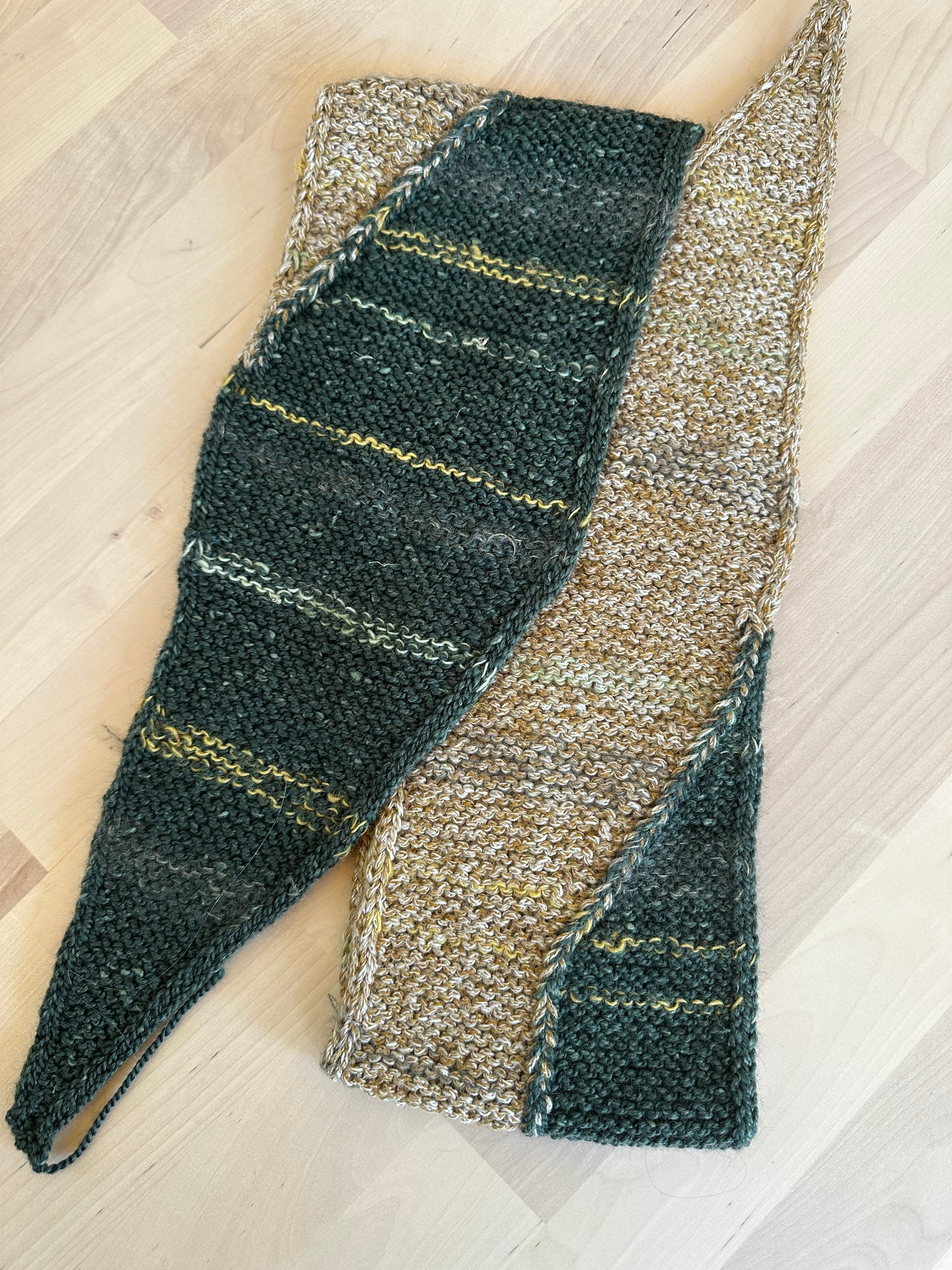
For so many of us, being alive right now means getting through the day slowly and with care, continuing on within and despite the unbearable tensions that surround. Two months in to life in my tiny house on the farm, one mile over a dirt road that is eight miles from town, I’m hunkering down by the old barn, learning this land and its rhythms while grounding my brain, my body, and my spirit with the basics: clearing the blackberry brambles, inventing new dishes for squash and cherry tomatoes, petting the cow while somebody else milks her, writing a bit, and knitting always knitting one stitch and then another and another. Trying to make something beautiful out of this day, this life.
Summer’s 100-plus-degree days are turning to cool nights that refresh followed by chilly mornings that invigorate my tired self. Schools are back in session, and for the third year in a row I am nowhere near a college campus. The distance still feels like a blessed reprieve from the pain of a life I wasn’t supposed to be living. This healing is a slow process, isn’t it?
September also hails the Sierra Nevada Yarn Crawl — its seventh, my third. I like to say that it’s like a pub crawl, but with much less drinking and a lot more driving. Others call it traveling fiber appreciation days. Readers who have been with me for a while may remember that I had always wanted to complete yarn crawls in when I lived in New England, but work responsibilities prevented me from even trying. Here, with Lake Tahoe as our center of gravity, eight local yarn stores in California and Nevada collaborate on four days of trunk shows, special colorways, new designs, custom kits, raffles, giveaways, community projects, and a sense of belonging. This year the stores provided name tags that included “currently working on …” as an ice breaker. Lengthy collegial conversations erupted among even the most neurodivergent introverts who crawl: oh wow, did you make your beautiful top (shawl / scarf / tote bag / skirt / vest)? What yarn did you use? What is the name of the pattern (designer / site)? I just love the hue (texture / combination / lace / colorwork / buttons / shawl pin) you chose. What store are you going next? Maybe I’ll see you there.
For those four days, we live in a world of good will and good intentions, of deep appreciation for the different skills and sensibilities our fellow creatures bring into the circle. We see — and experience — the curated best of one another.
This year, however, I just couldn’t muster the 279 miles it would take to visit all eight of the participating yarn stores. In 2023, I spent the night in South Lake Tahoe, and 2024 in Reno, but this year no overnight adventures compelled me to even try. My spirit may be trying to soar, but my body and brain are still depleted. So I imagined that if runners can make a legitimate thing out of “half-marathons,” then I could do the same for a “half-crawl.”
And so, I half-crawled my way through California, leaving Nevada for next year.
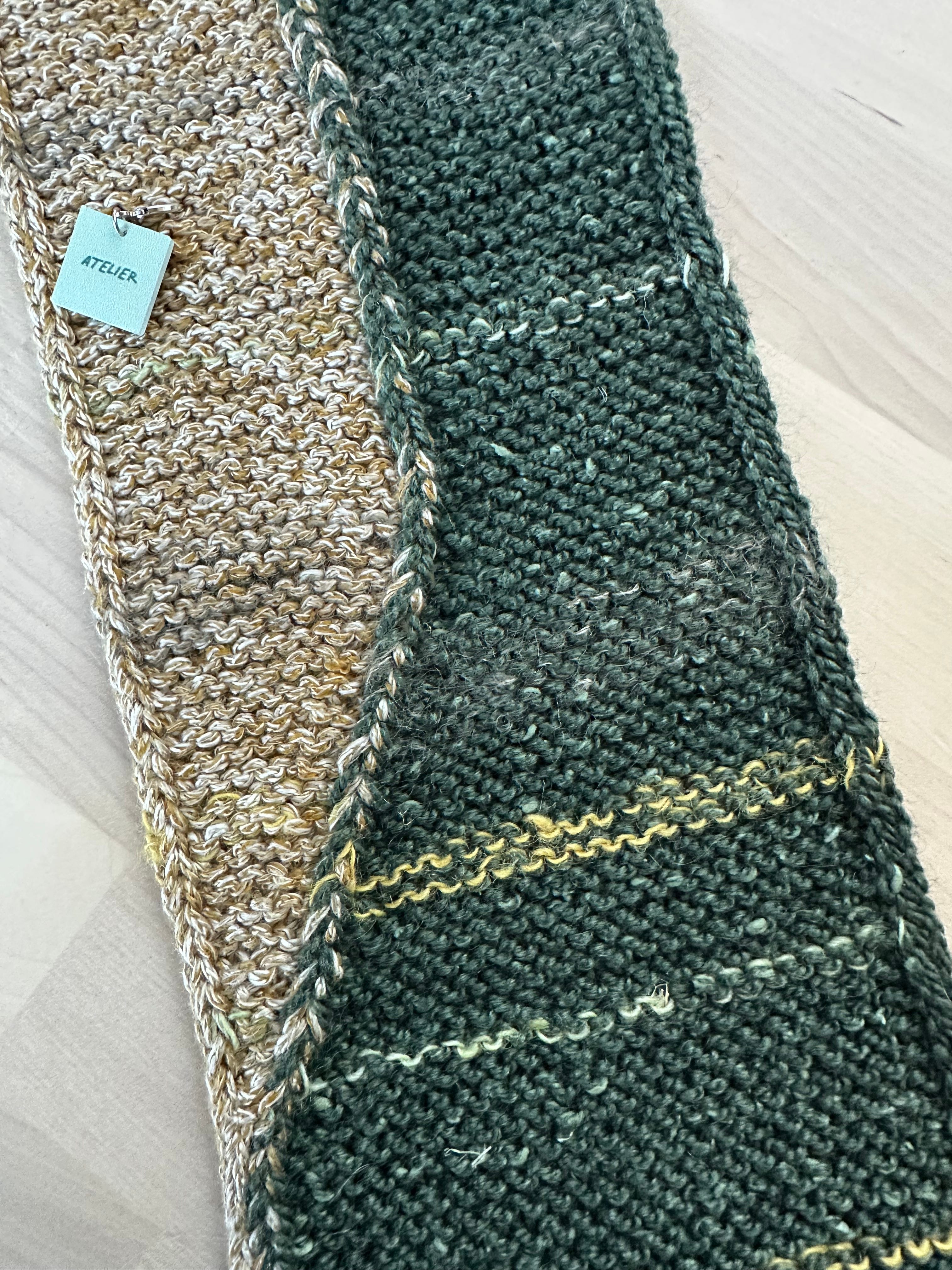
Atelier Truckee’s Common Strand Scarf
Each shop offers a Featured Pattern designed just for the year. My home shop, Heathered Yarn Co in Grass Valley, created throw pillows by knitting mitred squares in autumnal jewel tones hand-dyed by Heather herself, while my favorite weaving shop, Lofty Lou’s in Placerville, compiled kits for a woven handbag complete with leather handles and a fabric lining. I returned home with one of each and am eager to cast on my needles and warp my loom. That said, it was Atelier Truckee’s featured pattern that promised to soothe what ails me. You know I love a good metaphor.
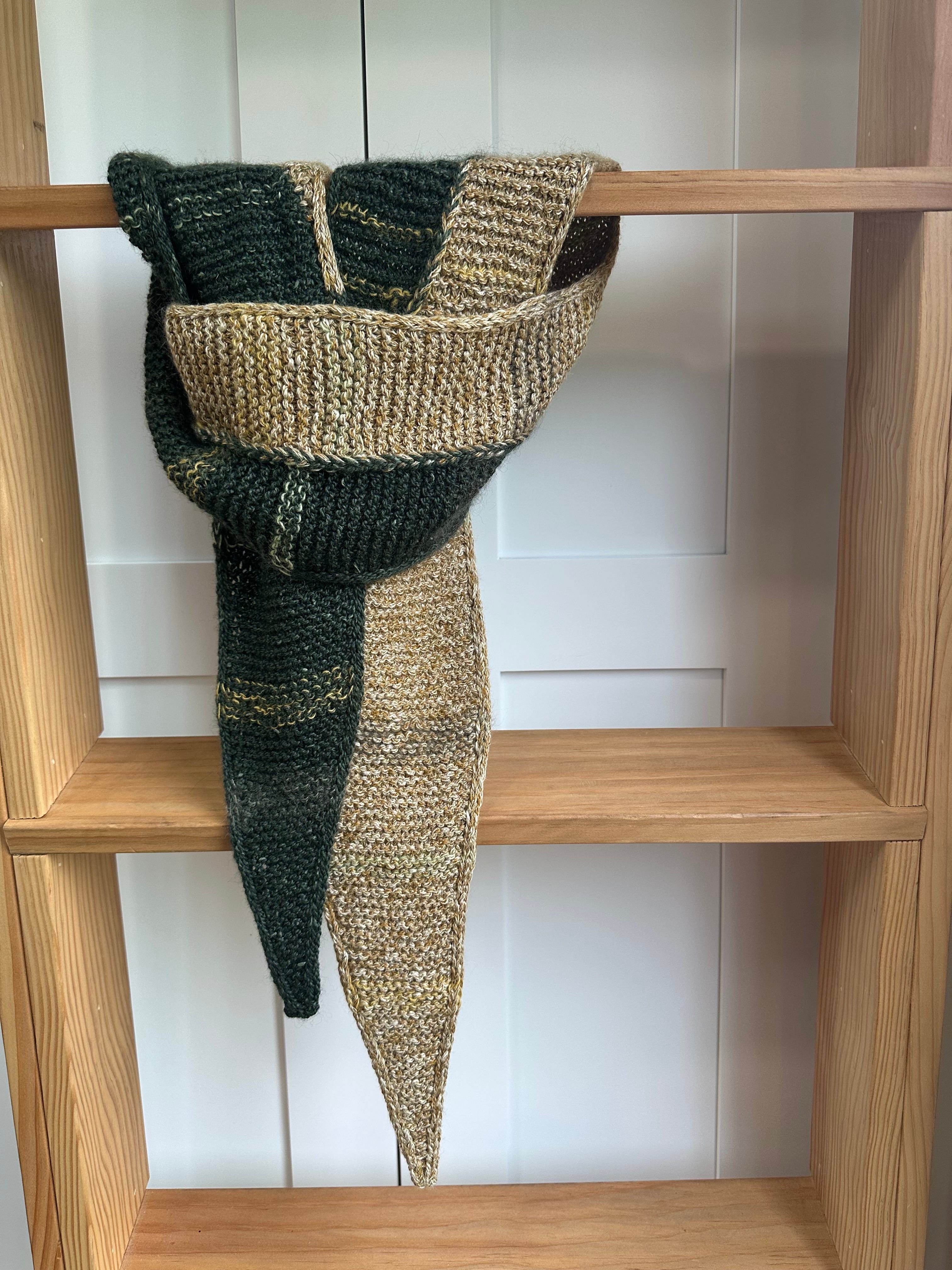
Atelier’s “Common Strand” scarf was designed collaboratively by locals Heather (yes, they have a Heather, too!) and Jess. It is essentially a skinny scarf of two contrasting colors divided down the middle.
Perhaps you can see where this is going.
Atelier’s featured patterns always play with color and texture, and they pre-package kits with all the yarn you need to complete the project. Browsing through the breadth and depth of their kits is an annual highlight for me. Heather and Jess don’t just find two or three groupings that work, but rather they offer dozens upon dozens — each one different and uniquely, thoughtfully its own. Both Jess and Heather each, separately, acknowledged the care and joy they put into finding effective combinations. As she makes her selections, Jess asks herself, “what would I want to play with alongside this yarn?” That sense of play is palpable as I search through the multitudes on display to find the one that speaks to me.
It starts easily enough: a few stitches of a sienna-toned blend of merino, baby alpaca, and silk. Adding a few stitches every few rows, you add a color pop (in my case a very soft one, barely detectable), returning to the basic single-strand after a few rows. But then another color pop disrupts again, and then it’s back to basic for a while before a long stretch of mohair joins the party. Each of these additions is subtle in my project, as if something is building and you can just barely see or feel it. But I knew they were there, just as I knew all those ends would need to be woven in eventually.
There, in the space between zig and zag, all colors of threads knit are together. This is the common strand, the point of connection. Individual row by individual row, that connection is fleeting, only there for a single stitch. But that single combination stitch, repeated row after row after row for several feet, begins to look braided, intentional. Not a rift but rather a visible seam between two very different identity profiles.
In knitting parlance, this joining technique is called intarsia. I’d long heard of it as an especially challenging technique but had never tried it. Did I know I would be learning intarsia when I purchased the pattern? No. But I’m glad I did. It’s really not that difficult, and therein lies the genius of Jess and Heather’s design. They made it accessible not just to knit, but also to understand. Intarsia typically hides the braid-like connection on the backside, invisible; in this scarf, the join is the point.
Am I just making this up, reading too much into it? Has my over-developed sense of metaphor made me go off the rails? My hope for humanity so potent I see it in places it might not belong? I don’t think so. Heather and Jess may not have articulated this as their design concept, but I felt it in each stitch, an embodied knowing that this project meant something more.
Then, as I walked through the book section at the front of the store, their display was filled with some of the same books I have in my own home library — books that made the cut as I was downsizing for my tiny home: Farming While Black, The Warmth of Other Suns, Me and White Supremacy, Between the World and Me, Why Are All the Black Kids Sitting Together in the Cafeteria?
I see you, Craftivists. I feel the intentions in your designs, hear the outrage in your yarn choices, and taste the hope you imbue one stitch at a time over and over and over and over again. It is literal and it is metaphorical. Thank you for keeping at it.
I’m glad you waited a bit to publish; I think we all need this even more now.
Thank you for this. Beautiful writing, beautiful knitting!
I'm glad it was time to press send. 💙🧶